
The Verse That Made Me Pause
وَءَاتَىٰكُم مِّن كُلِّ مَا سَأَلۡتُمُوهُۚ وَإِن تَعُدُّواْ نِعۡمَتَ ٱللَّهِ لَا تُحۡصُوهَآۗ إِنَّ ٱلۡإِنسَٰنَ لَظَلُومٞ كَفَّارٞ
While reciting Surah Ibrahim, I paused at a verse I had read many times before:
“He gave you from all that you asked of Him. If you tried to count Allah’s blessings, you could never enumerate them. Indeed, humankind is truly unfair and ungrateful.”
—Qur’an 14:34
I read it again.
How could Allah say that He has given us from all that we asked when so many of us carry a long list of unmet needs? We have prayers that remain unanswered, careers that never began, relationships that did not last, opportunities that passed us by, and hopes that seem permanently out of reach.
Yet perhaps the problem is not the verse. Perhaps it is the way we define need.
Much of what we call a need is, in reality, a desire made urgent by comparison, expectation, and habit. We need food, but not endless variety. We need shelter, but not prestige. We need provision, but not necessarily affluence. We need love and companionship, but not always from the one particular person upon whom we have fixed our hopes.
The Qur’an is not saying that every wish will be granted exactly as we imagine it. It is reminding us that Allah has already given us from every category of provision necessary for life, often before we knew how to ask.
Blessings Before We Learned to Ask

We never asked for lungs before our first breath. We never requested a heart, a liver, a nervous system, or a brain. The infant does not ask for milk, yet milk is prepared before hunger can be named. Some of our greatest prayers were answered before we learned the language of prayer.
We eat, and the body performs a hidden miracle. Food is broken down, nutrients are absorbed, energy is produced, waste is removed. The heart beats without instruction. The lungs breathe while we sleep. The immune system fights enemies we never see. Wounds close. Bones repair. Cells renew.
The body labours for us in silence.
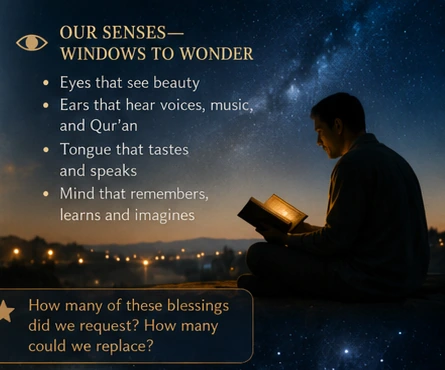
We open our eyes, and light becomes colour, distance, movement, and beauty. The ears turn vibrations into voices, music, warnings, memories, and Qur’an. The tongue tastes, speaks, and carries meaning across languages. The brain stores faces, grief, knowledge, love, and entire worlds of memory.
How many of these blessings did we request?
How many could we replace if they were taken away?
The World Already Sustaining Us
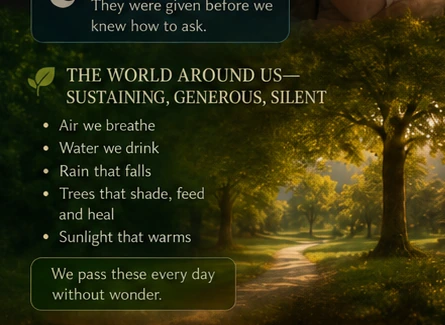
Then there is the world around us. Air surrounds us freely. Gravity holds us to the earth. Rain falls. Seeds split open. Trees rise from soil and turn sunlight into shade, fruit, medicine, and wood.
We pass trees every day without wonder, although a living forest may be one of the rarest sights in the known universe.
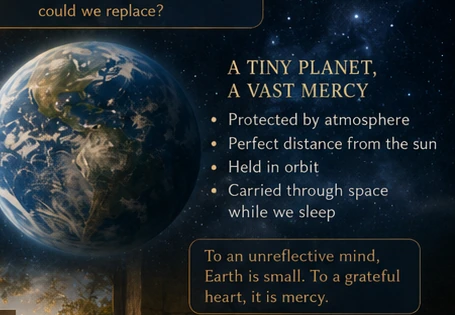
When Voyager 1 photographed Earth from the edge of the solar system, our planet appeared as a pale blue dot suspended in darkness. To an unreflective mind, its smallness may suggest insignificance. But to a grateful heart, it reveals mercy.
This tiny planet moves through an immense and hostile universe, yet it carries oceans, forests, animals, language, prayer, consciousness, and love. An atmosphere protects us. The sun warms us from a life-sustaining distance. The earth remains in its course while we sleep.
We do not calculate cosmic radiation before stepping outside. We do not fear that the planet will lose its orbit overnight. We live in a home suspended in space, and familiarity has made the miracle invisible.
This is why the verse comes after Allah mentions the heavens, the earth, rain, rivers, ships, the sun, the moon, night, and day. Before we count what is missing, the Qur’an asks us to look at what is already holding us.
When Desire Expands Faster Than Gratitude
The difficulty is that human desire expands faster than gratitude.
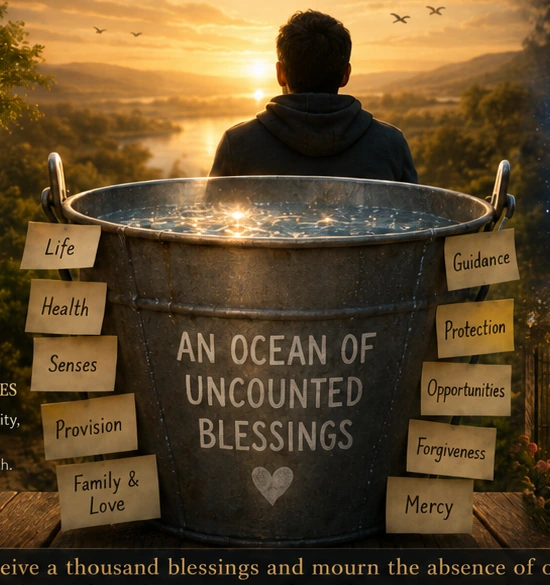
We receive a thousand blessings and mourn the absence of one.
A specific job did not come. A business deal failed. A person we wanted chose another path. These losses are real, and faith does not require us to pretend otherwise. Islam does not teach emotional numbness. Ya‘qub wept for Yusuf. The Prophet Muhammad ﷺ grieved those he loved.
But faith teaches sorrow its proper size.
A closed door may be painful, but it is not the end of Allah’s provision. One disappointment does not cancel every mercy. One unanswered prayer does not mean we have been abandoned.
Faith Gives Sorrow Its Proper Size

Sometimes Allah gives by granting.
Sometimes He gives by delaying.
Sometimes He gives by redirecting.
And sometimes He gives by withholding what would have harmed us.
Gratitude is not denial. It does not tell the sick that pain is unreal, the poor that hardship is imaginary, or the oppressed that injustice should be accepted. Gratitude does not prevent us from seeking treatment, justice, work, security, or a better life.
Gratitude simply prevents pain from becoming blindness.
It allows us to say: something precious is missing, but not everything has been taken from me.
Learning to See What Is Sustaining Us
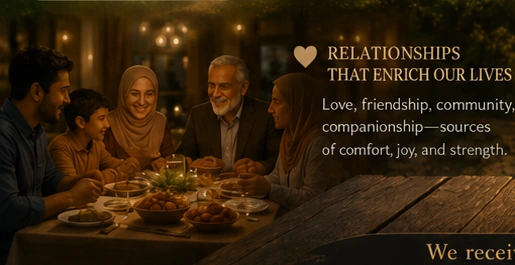
Perhaps one of Allah’s greatest gifts is not more possession, but clearer perception. The grateful person may own less and yet experience more: more peace in a modest home, more sweetness in a simple meal, more wonder in an ordinary sky, more love in a quiet conversation.
The ungrateful heart stands inside a garden and complains about the flower it cannot reach. The grateful heart notices that even the ability to see, desire, reach, and hope is itself a gift.
Perhaps I struggled with the verse because I was counting only the things I wanted, while Allah was pointing to the things sustaining me.
I was counting closed doors. Allah was counting heartbeats.
I was counting delays. Allah was counting breaths.
I was counting disappointments. Allah was counting every meal, every protected night, every functioning organ, every danger turned away, and every mercy that reached me before I knew I needed it.
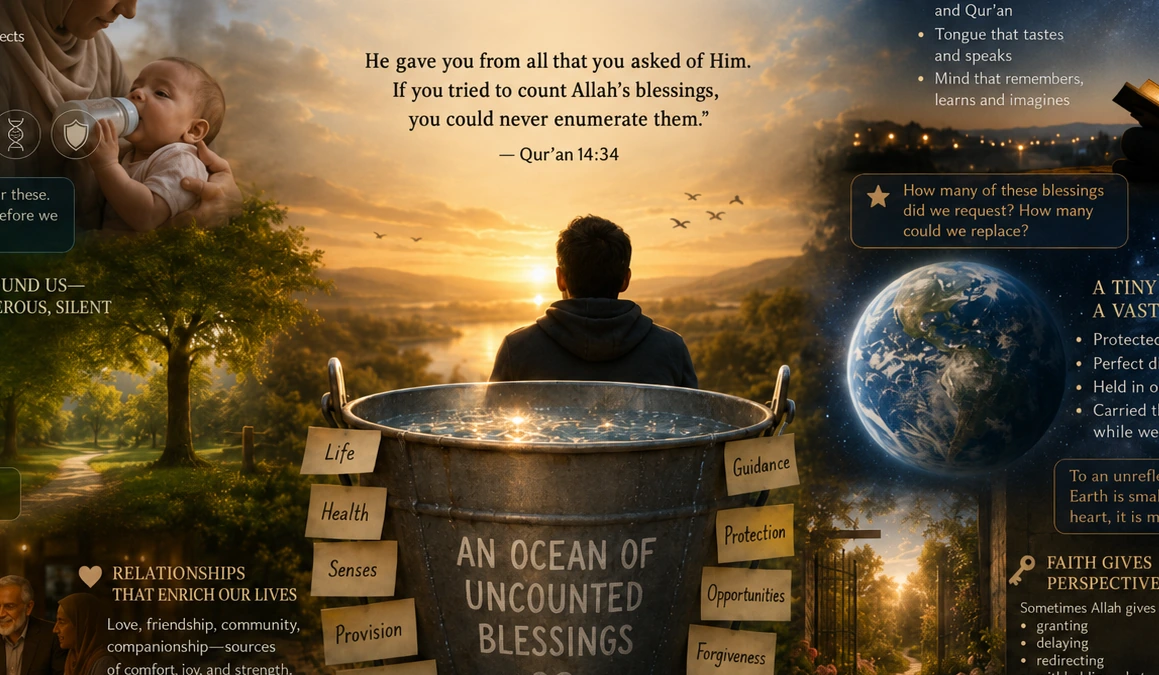
The bucket I thought was full of unmet needs was, in truth, floating in an ocean of uncounted blessings.
An Ocean of Uncounted Blessings

Life will not give us everything we desire. But Allah has given us life itself, and within it, countless signs of His care.
Perhaps the purpose of life is not to possess everything we can imagine. Perhaps it is to awaken before we leave—to recognize the extraordinary hidden inside the ordinary, to receive without arrogance, to lose without despair, and to realize, before it is too late, how completely we were surrounded by mercy.
Send a Comment
Your comment will be sent privately to the MCC Newsletter team and will not be published on the website.