
Long before the modern camera taught the world to expect a sea of white circling the Kaaba, the pilgrimage looked stranger, rougher, and far less uniform. In one of the most arresting reconstructions of pre-Islamic pilgrimage, the historian F. E. Peters describes a sanctuary in Mecca where not every pilgrim arrived dressed alike, or even dressed at all. Under the old Quraysh system, some outsiders could not circumambulate the shrine unless they borrowed proper garments from the elite “Hums.” If they had none, they might go around naked; if they used their own clothing, those clothes could be discarded afterward as “cast-offs.”¹
That backward telling misses the real fascination. The pilgrimage was old before Islam, and, as some historians argue, many of its core rites were already recognizable in the generation before the Prophet Muhammad.² What Islam did was not invent sacred movement from nothing, but reform it: stripping out pagan privileges, disciplining the clothing code, and binding dress more tightly to ritual purity and moral equality. The result was ihram, though even that word is slippery. As later legal and scholarly works make clear, ihram is first a state of consecration, and only secondarily the clothing associated with it.³
Before White Took Over
In the earliest Islamic sources, the rules of men’s ihram are strikingly minimal and mostly negative. A famous hadith preserved in the early legal tradition does not announce a uniform so much as forbid certain garments: no shirt, no trousers, no turban, no hooded cloak, no leather footwear covering the ankles unless necessary, and no garments scented or dyed with saffron.⁴ Women, meanwhile, were told not to cover the face with a niqab or wear gloves, but they were not assigned a standardized two-piece outfit. What the law cared about first was not a specific color or cut, but the renunciation of tailored, status-marking clothing.
That is why the early record on color is so revealing. Historical studies of early Islamic dress note that multiple colors—red, green, black, and white—were worn in the Prophet’s time, with restrictions falling primarily on specific dyes like saffron rather than on color in general.⁵ In other words, the textual foundation did not begin with “white only.”
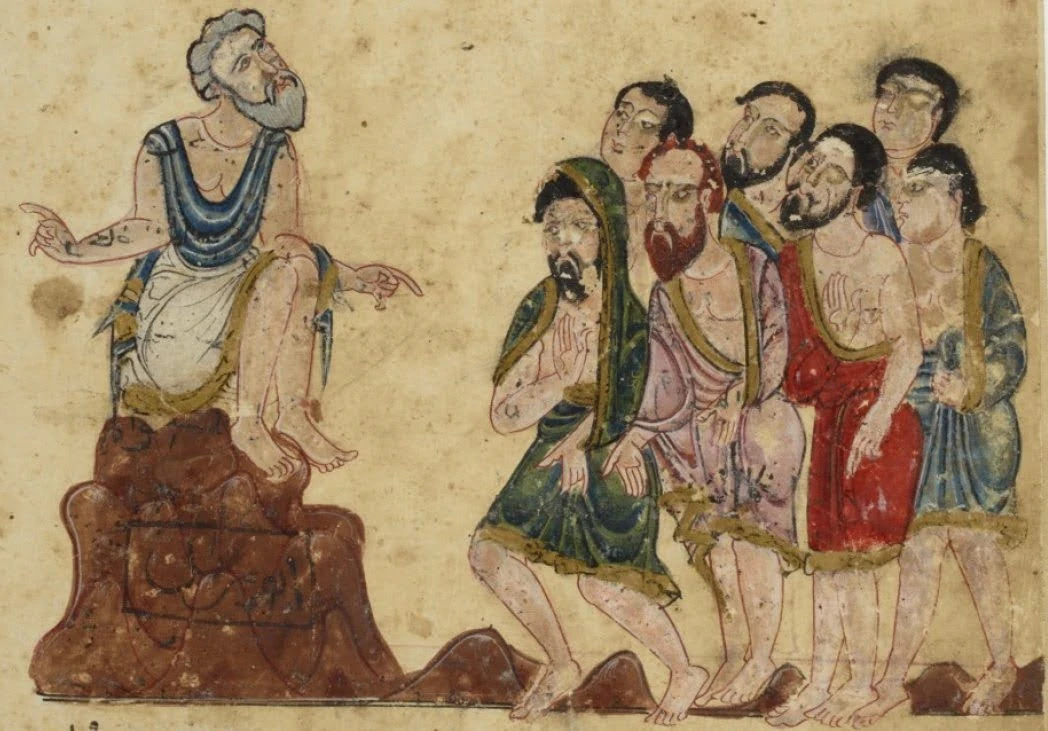
Just as important, visual evidence complicates the modern picture even further. As Yedida Kalfon Stillman shows in her survey of Islamic dress, medieval manuscript illustrations depict pilgrims in a range of subdued tones, not exclusively white, and often wearing garments that look noticeably different from today’s standardized ihram.⁶
How Law Met Cloth
Color
If white dominates today, it did not do so from the beginning. Rather, it rose gradually from recommendation to expectation. Later scholarship shows how jurists and commentators came to associate white with purity, piety, and burial symbolism, elevating it above other permissible colors.⁵ Over time, legal schools increasingly recommended clean white garments for men entering ihram, even though earlier texts had not mandated it.
This is a pattern seen often in religious practice: the law sets boundaries, but culture fills them in. Classical jurists agreed on the basic principle—unstitched garments for men, modest dress for women—but differed in emphasis. Legal texts describe the lower garment (izar) as covering from the navel to the knees, establishing a minimum standard rather than a fixed style.⁷
By the early modern period, white had clearly become dominant in key ritual moments. A Mughal-era illustrated pilgrimage manuscript shows pilgrims in white garments while in the sacred state, even as it carefully distinguishes regional groups—North Africans, Egyptians, Syrians, Indians, and Persians—outside those moments.⁸ The visual message is subtle but powerful: unity during ritual, diversity outside it.
Length
Length followed a similar trajectory of variation. If one expects a timeless, ankle-length garment, the historical record is surprisingly uncooperative. Manuscript evidence analyzed by Stillman shows that earlier wrapped garments—similar to the izar—were often shorter, sometimes reaching only to the knee.⁶
This aligns with the legal framework. The requirement to cover from the navel to the knees was not a tailoring instruction but a modesty threshold.⁷ From there, real-world factors—climate, fabric size, movement, and crowding—shaped how garments were actually worn. What mattered was coverage, not uniformity.
Empires, Markets, and Standardization
By the Ottoman period, the pilgrimage had become a vast logistical enterprise, and logistics reshaped clothing. Suraiya Faroqhi notes that pilgrims in seventeenth-century Mecca could purchase ihram cloth locally, suggesting that ritual dress was already embedded in a broader commercial system.⁹
This commercialization likely played a quiet but important role in standardization. When garments are bought rather than improvised, they tend to become more uniform.
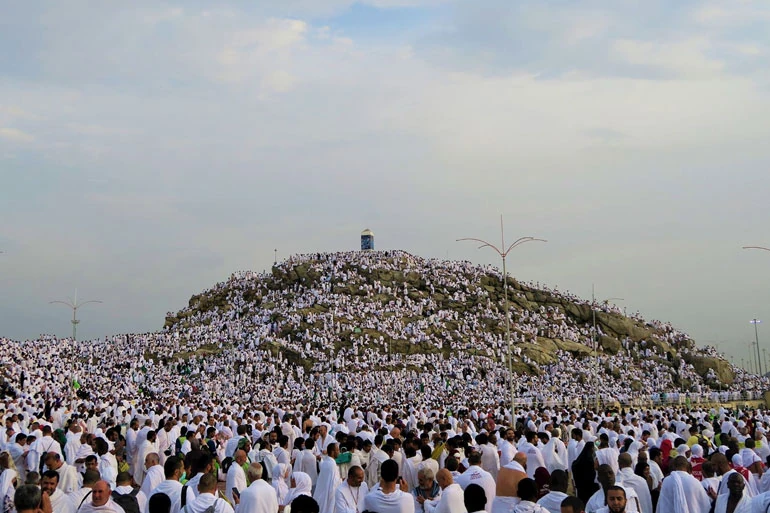
By the early twentieth century, the transformation was unmistakable. A European observer writing about the Hajj described how, upon approaching Jeddah, “all pilgrims were already wearing their white ihram clothing.”¹⁰ Even elites who had traveled in distinctive regional dress adopted the same simple white garments before entering the sacred state.
White had not been imposed—it had become expected.
What the Cloth Means Now
And yet the uniform never became fully uniform. Women’s ihram remains the clearest example: there is no single prescribed garment, only the requirement of modest dress, and color is not restricted.⁷ Even among men, differences persist beneath the apparent sameness. Modern ethnographic studies show that pilgrims notice variations in fabric quality, cost, and texture—cheap cotton versus high-quality cloth, synthetic versus natural fibers.¹¹
This gap between text and lived reality is not a flaw. It is the normal condition of religious practice. The law defines a framework—detachment, humility, equality—while culture interprets and expresses it.
Modern writers have layered additional meaning onto the white garments. Studies of early twentieth-century pilgrimage accounts show how reformist thinkers framed ihram as a symbol of simplicity, anti-luxury, and even social equality.¹²
That may be the deepest lesson of this history. Ihram endures not because it has remained unchanged, but because it has remained meaningful. It is both stable and flexible: rooted in early practice, yet shaped by centuries of interpretation, trade, and movement.
The white garments seen today—so uniform from a distance—are the result of a long historical process. And their power lies precisely in that paradox: beneath the simplicity of two unstitched cloths lies a complex story of law, culture, and human adaptation.
References
- F. E. Peters, The Hajj: The Muslim Pilgrimage to Mecca and the Holy Places (Princeton: Princeton University Press, 1994).
- Ṣaḥīḥ al-Bukhārī, Book of Ḥajj, hadith no. 1838, https://sunnah.com/bukhari:1838.
- “Ihram,” in The Five Schools of Islamic Law, by Muhammad Jawad Mughniyya, https://al-islam.org/five-schools-islamic-law-muhammad-jawad-mughniyya/ihram.
- Yedida Kalfon Stillman, Arab Dress: From the Dawn of Islam to Modern Times (Leiden: Brill, 2000), https://archive.org/stream/ArabDress.FromTheDawnOfIslamToModernTimesByYedidaKalfonStillman/Arab%20Dress.%20From%20the%20Dawn%20of%20Islam%20to%20Modern%20Times%20by%20Yedida%20Kalfon%20Stillman_djvu.txt.
- Hadas Hirsch, “Clothing and Colours in Early Islam,” https://www.researchgate.net/publication/341797441_Clothing_and_Colours_in_Early_Islam.
- Suraiya Faroqhi, “Pilgrims and the Hajj under the Ottomans,” in The Hajj in the Modern World, https://books.openedition.org/pur/45355.
- Safi ibn Vali, illustrated pilgrimage manuscript (Mughal period), Islamic Art Museum database, https://islamicart.museumwnf.org/database_item.php?id=object%3BEPM%3Buk%3BMus22%3B27%3Ben.
- C. Snouck Hurgronje (attrib. Van der Hoog account), The Hajj and Europe in the Age of Empire, https://archive.org/stream/dli.doa.094/094_djvu.txt.
- “Pilgrimage and Identity: The Hajj Experience,” Journal of Critical Race Inquiry / University of Toronto, https://jps.library.utoronto.ca/index.php/ijidi/article/download/32267/24686/77086.
- Ammeke Kateman, “Fashioning the Materiality of the Pilgrimage: The Hajj Travelogue of Muhammad Labib al-Batanuni,” https://www.researchgate.net/publication/340576084_Fashioning_the_Materiality_of_the_Pilgrimage_The_hajj_Travelogue_of_Muhammad_Labib_al-Batanuni.
- Peter Webb, “The Hajj before Muhammad: The Early Evidence,” in Journal of Arabian Studies (or similar scholarly discussion of pre-Islamic pilgrimage traditions).
- “Ihram,” Encyclopaedia of Islam / Brill (conceptual discussion of ihram as ritual state), https://www.degruyterbrill.com/document/doi/10.1515/mill-2023-0004/html.