
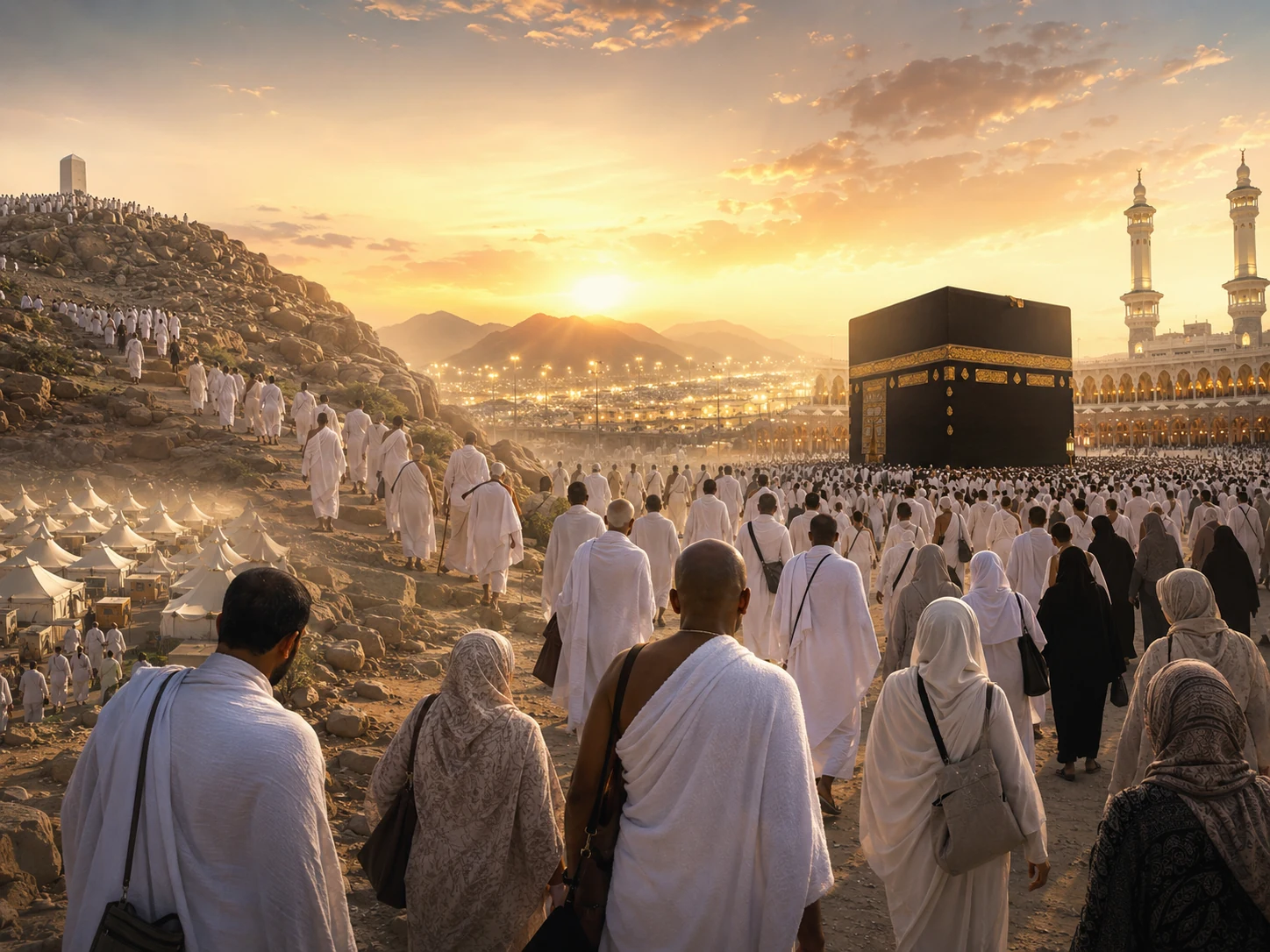
At dawn, the plain of Arafat does not look like the center of the world. It looks like dust and light—heat already rising, white garments stretching in every direction, faces turned upward in a quiet urgency. A man stands alone, palms raised, whispering words he has carried across continents. Not far from him, a woman weeps without restraint, her voice dissolving into the murmur of millions. No one knows each other, yet something unmistakable binds them: a shared return.
This is Hajj—not simply the largest gathering on earth, but a return. A return to God, to truth, and to the self beneath everything we have layered upon it.
The Qur'an frames Hajj not as spectacle, but as purpose: a call to witness, to remember, and to become. Pilgrims are invited “that they may witness benefits for themselves and mention the name of God on known days” (22:28). These benefits are not merely logistical or communal—they are deeply interior. Hajj interrupts the inertia of everyday life. It dismantles routine, dislodges complacency, and calls the human being back to a clarity long obscured.
Human beings, the Qur’an reminds us, are forgetful. We drift. We become absorbed in the immediacy of the world—work, family, ambition—until the deeper orientation of life fades into the background. Daily prayers and the fast of Ramadan offer regular recalibration. But Hajj is different. It is not simply renewal—it is return.
Not a journey forward, but a journey back.
Back to a state of awareness we once knew. Back to a purity we were created upon but rarely sustain.
This return begins long before arrival. Months, sometimes years, of preparation precede the journey. Wealth is set aside with intention. Bodies are readied. Hearts are quietly trained. The pilgrim studies each rite—not as a checklist, but as a language that must be spoken with sincerity. As Ibn Taymiyyah observed, the outward form of worship without inward truth is like a body without a soul. Hajj demands both: the visible act and the invisible return.
And then, suddenly, all markers of identity are stripped away.
In the state of ihram, pilgrims wear simple, unstitched cloth. Titles dissolve. Status disappears. Wealth becomes irrelevant. The executive and the laborer stand indistinguishable. What remains is something far more honest: the human being as they were meant to be.
More than fourteen centuries ago, Prophet Muhammad stood before a vast gathering and declared that no Arab is superior to a non-Arab, no white to a black, except in piety. In Hajj, this is not a historical statement—it is a lived return to human equality. A Nigerian farmer, an Indonesian teacher, a Canadian physician—all circle the Kaaba in the same motion, uttering the same words, seeking the same mercy.
For some, this equality is not just observed—it is revolutionary.
When Malcolm X performed Hajj in 1964, he encountered something that transformed his worldview. Having come from a society deeply fractured by racial division, he wrote of seeing “people of all colors, from blue-eyed blondes to black-skinned Africans” sharing the same space, the same rituals, the same devotion. What struck him most was not diversity—but its disappearance. In his words, he witnessed a brotherhood so genuine that it compelled him to reconsider his earlier views on race. Hajj, for him, was not simply a journey—it was a return to a truth he had not fully seen before: that human dignity is not determined by color, but by consciousness of God.
Sociologists have long tried to describe such moments. Émile Durkheim called it “collective effervescence,” a term from his study of religious life, where individuals transcend their separateness and experience a unified consciousness. But Hajj goes further. It is not only a convergence of bodies—it is a return of hearts, aligned in a single direction.
Every chant of Labbayk Allahumma labbayk—“Here I am, O God, here I am”—is not just a response. It is a recognition. A return to a call that was always there.
That call traces back to Prophet Ibrahim.
His life was defined by surrender. When commanded to leave his family in a barren valley, he obeyed. When asked to sacrifice what he loved most, he did not hesitate. His son, Ismail, did not resist. “O my father,” he is reported in the Qur’an to have said, “do as you are commanded; you will find me, if God wills, among the patient” (37:102).
This was not a story of loss—it was a return. A return to placing God above everything else.
Few modern writers captured this sense of return as vividly as Muhammad Asad. In his reflections on the pilgrimage, he described Hajj not merely as movement through space, but as movement toward meaning—a shedding of the artificial layers of civilization in order to rediscover a primordial simplicity. For Asad, the journey was a reminder that beneath the complexities of modern life lies a more fundamental truth: that the human being, at their core, is oriented toward God.
In the end, the sacrifice of Ibrahim was replaced. The lesson was made clear: God does not desire blood, but sincerity. “Neither their meat nor their blood reaches God, but it is your piety that reaches Him” (22:37). Hajj preserves this truth. Every act, every movement, every hardship becomes a way of returning to that sincerity.
And hardship is unavoidable.
Under the blazing sun of Arafat, across the open expanse to Muzdalifah, within the crowded tents of Mina—the pilgrim is gradually stripped of illusion. Comfort fades. Control slips. What remains is something raw and unfiltered: a human being aware of their need.
Modern research on pilgrimage and ritual experience suggests that shared hardship, when infused with meaning, can reshape identity and deepen commitment. In Hajj, this is not accidental—it is structured. Hardship is not an obstacle to the journey; it is the mechanism of return.
Discipline, too, plays a central role.
In ihram, even permissible acts are suspended. Intimacy, argument, even harming a small creature are forbidden. The Qur’an commands: “There is to be no obscenity, no wrongdoing, and no disputing during Hajj” (2:197). This is not merely restriction—it is refinement. A return to moral clarity.
Al-Ghazali described the heart as something that must be trained until it responds naturally to truth. Hajj compresses that training into days. Every action becomes deliberate. Every interaction carries weight. Even in the immense crowd, the pilgrim must remain aware—careful not to harm, patient despite discomfort, restrained despite exhaustion.
And yet, despite all of this, pilgrims do not leave depleted. They leave restored.
The Prophet ﷺ taught that whoever performs Hajj sincerely, free of obscenity and wrongdoing, returns as pure as the day they were born—a promise preserved in authentic hadith collections such as those of Bukhari and Muslim. It is a complete moral return. A resetting of the human condition.
But perhaps the deeper transformation lies beyond forgiveness.
Before Hajj, the world feels central. After Hajj, it feels reoriented. The pilgrim does not abandon life—but returns to it differently. Attachments loosen. Priorities clarify. The heart, once scattered, becomes anchored.
Even the preparation for Hajj reflects this return. It demands discipline in saving, patience in planning, and intention in spending. It teaches that not all investments are immediate—some are eternal. In a world driven by consumption, Hajj becomes a return to purpose.
In the end, Hajj is not defined by the rituals alone. It is defined by what those rituals restore.
A distracted person returns attentive. A hardened heart returns softened. A fragmented life returns aligned.
And somewhere, perhaps again on that plain of Arafat, as the sun lowers and the sky softens, a pilgrim raises their hands one last time. Nothing outward has changed. The same desert. The same crowd. The same world waiting beyond the journey.
But inwardly, something has been returned.
Hajj does not merely gather people. It is the great return—to God, to the self, and to the truth we were created to live.